Kings of Israel and Judah Chart
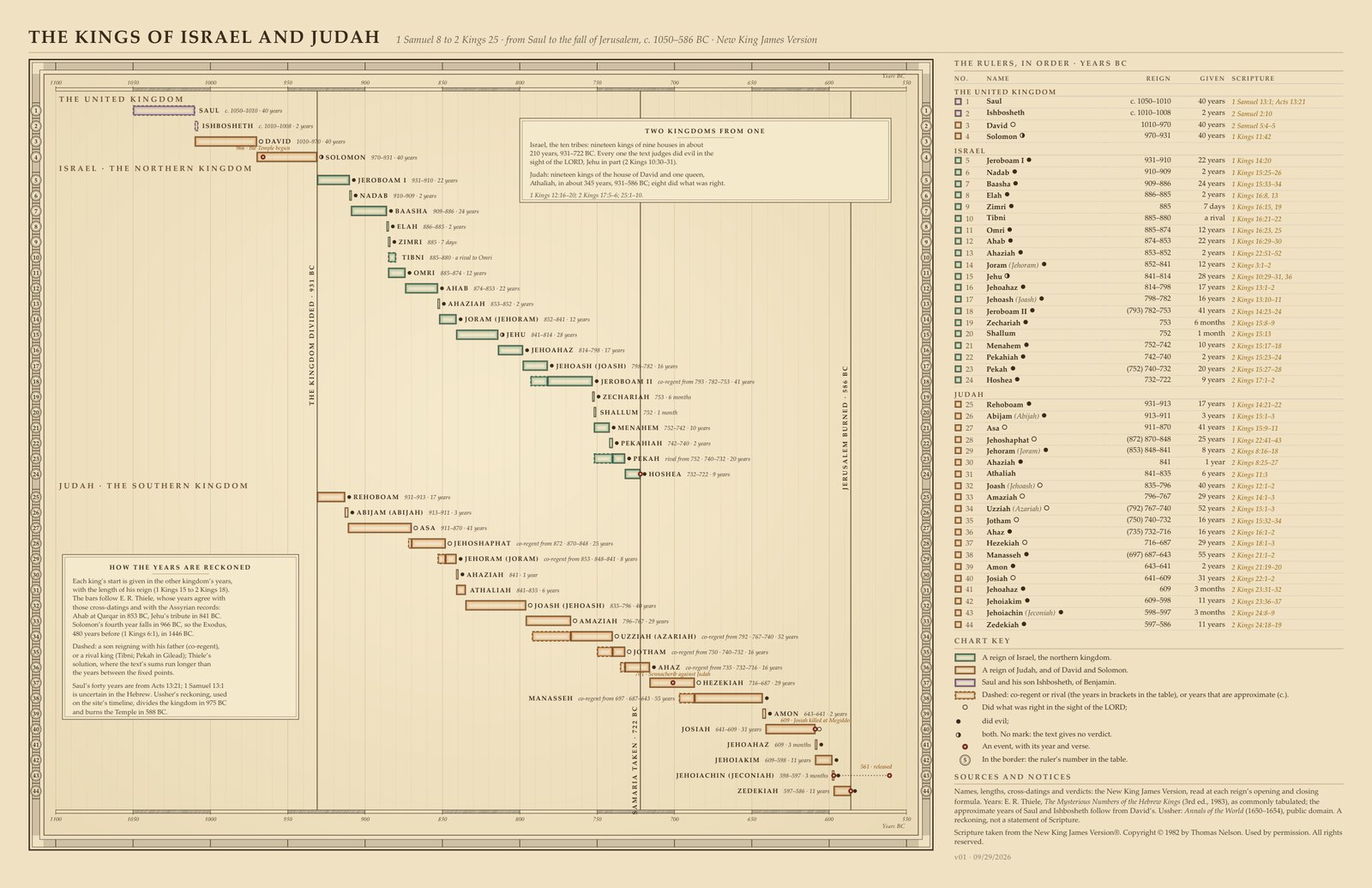
The Kings of Israel and Judah · 1 Samuel 8 to 2 Kings 25: forty-four rulers of Israel and Judah on one scale of years, from Saul to Zedekiah
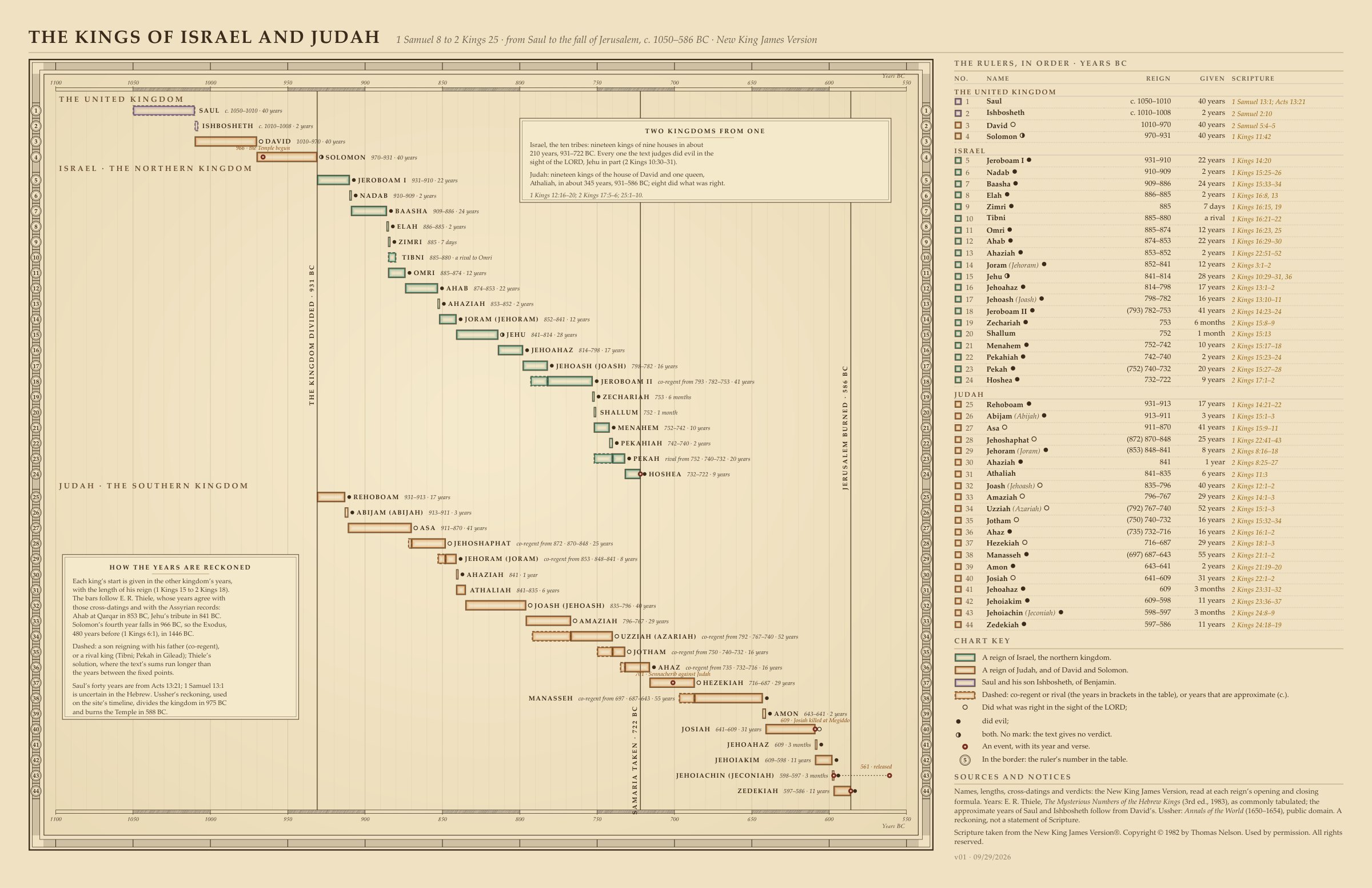
The Kings of Israel and Judah, version 1. Sources: the New King James Version, E. R. Thiele’s years and Ussher’s Annals as a check. Click the chart to enlarge.Full size
Forty-four rulers of Israel and Judah, Saul to Zedekiah, on one scale of years. Each reign is a bar from its start to its end, so you can see at a glance who ruled alongside whom. Co-regencies and rival reigns are drawn dashed, and a ring, a disc, or both beside each bar marks the text’s own verdict on that reign.
The chart marks the kingdom’s division in 931 BC, the fall of Samaria in 722 BC and the burning of Jerusalem in 586 BC, with Solomon’s Temple begun, Sennacherib’s invasion of Judah, Josiah’s death at Megiddo and Jehoiachin’s release noted along the way. Two framed notes explain how the years are reckoned and set the two kingdoms side by side. A table gives every ruler’s years, length of reign and verse.
Years follow E. R. Thiele, The Mysterious Numbers of the Hebrew Kings (3rd ed., 1983), as commonly tabulated. Saul’s forty years follow Acts 13:21; his and Ishbosheth’s years are approximate. Archbishop Ussher’s years, used on the site’s timeline, are noted for comparison: the division in 975 BC and the Temple’s burning in 588 BC.
Names and spellings follow the New King James Version. The years are a reckoning, not a statement of Scripture.
Chart by View.Bible.
When
1050–586 BC, as E. R. Thiele reckoned the years in The Mysterious Numbers of the Hebrew Kings (3rd ed., 1983), as commonly tabulated; co-regencies and rival reigns are drawn dashed, and Saul’s and Ishbosheth’s years are approximate; a reckoning, not a statement of Scripture (how the years are counted).
See it on the timeline →Downloads
The rulers, in order · years BC (44)
Years follow E. R. Thiele, as commonly tabulated; years in brackets are a co-regency’s or a rival’s start, and c. marks a year that is approximate. Verdict: right, evil, both, or blank where the text gives none.
| No. | Name | Kingdom | Years | Length | Scripture | Verdict |
|---|---|---|---|---|---|---|
| 1 | Saul | United Kingdom | c. 1050–1010 | 40 years | 1 Samuel 13:1; Acts 13:21 | |
| 2 | Ishbosheth | United Kingdom | c. 1010–1008 | 2 years | 2 Samuel 2:10 | |
| 3 | David | United Kingdom | 1010–970 | 40 years | 2 Samuel 5:4–5 | Right |
| 4 | Solomon | United Kingdom | 970–931 | 40 years | 1 Kings 11:42 | Both |
| 5 | Jeroboam I | Israel | 931–910 | 22 years | 1 Kings 14:20 | Evil |
| 6 | Nadab | Israel | 910–909 | 2 years | 1 Kings 15:25–26 | Evil |
| 7 | Baasha | Israel | 909–886 | 24 years | 1 Kings 15:33–34 | Evil |
| 8 | Elah | Israel | 886–885 | 2 years | 1 Kings 16:8, 13 | Evil |
| 9 | Zimri | Israel | 885 | 7 days | 1 Kings 16:15, 19 | Evil |
| 10 | Tibni | Israel | 885–880 | a rival | 1 Kings 16:21–22 | |
| 11 | Omri | Israel | 885–874 | 12 years | 1 Kings 16:23, 25 | Evil |
| 12 | Ahab | Israel | 874–853 | 22 years | 1 Kings 16:29–30 | Evil |
| 13 | Ahaziah | Israel | 853–852 | 2 years | 1 Kings 22:51–52 | Evil |
| 14 | Joram (Jehoram) | Israel | 852–841 | 12 years | 2 Kings 3:1–2 | Evil |
| 15 | Jehu | Israel | 841–814 | 28 years | 2 Kings 10:29–31, 36 | Both |
| 16 | Jehoahaz | Israel | 814–798 | 17 years | 2 Kings 13:1–2 | Evil |
| 17 | Jehoash (Joash) | Israel | 798–782 | 16 years | 2 Kings 13:10–11 | Evil |
| 18 | Jeroboam II | Israel | (793) 782–753 | 41 years | 2 Kings 14:23–24 | Evil |
| 19 | Zechariah | Israel | 753 | 6 months | 2 Kings 15:8–9 | Evil |
| 20 | Shallum | Israel | 752 | 1 month | 2 Kings 15:13 | |
| 21 | Menahem | Israel | 752–742 | 10 years | 2 Kings 15:17–18 | Evil |
| 22 | Pekahiah | Israel | 742–740 | 2 years | 2 Kings 15:23–24 | Evil |
| 23 | Pekah | Israel | (752) 740–732 | 20 years | 2 Kings 15:27–28 | Evil |
| 24 | Hoshea | Israel | 732–722 | 9 years | 2 Kings 17:1–2 | Evil |
| 25 | Rehoboam | Judah | 931–913 | 17 years | 1 Kings 14:21–22 | Evil |
| 26 | Abijam (Abijah) | Judah | 913–911 | 3 years | 1 Kings 15:1–3 | Evil |
| 27 | Asa | Judah | 911–870 | 41 years | 1 Kings 15:9–11 | Right |
| 28 | Jehoshaphat | Judah | (872) 870–848 | 25 years | 1 Kings 22:41–43 | Right |
| 29 | Jehoram (Joram) | Judah | (853) 848–841 | 8 years | 2 Kings 8:16–18 | Evil |
| 30 | Ahaziah | Judah | 841 | 1 year | 2 Kings 8:25–27 | Evil |
| 31 | Athaliah | Judah | 841–835 | 6 years | 2 Kings 11:3 | |
| 32 | Joash (Jehoash) | Judah | 835–796 | 40 years | 2 Kings 12:1–2 | Right |
| 33 | Amaziah | Judah | 796–767 | 29 years | 2 Kings 14:1–3 | Right |
| 34 | Uzziah (Azariah) | Judah | (792) 767–740 | 52 years | 2 Kings 15:1–3 | Right |
| 35 | Jotham | Judah | (750) 740–732 | 16 years | 2 Kings 15:32–34 | Right |
| 36 | Ahaz | Judah | (735) 732–716 | 16 years | 2 Kings 16:1–2 | Evil |
| 37 | Hezekiah | Judah | 716–687 | 29 years | 2 Kings 18:1–3 | Right |
| 38 | Manasseh | Judah | (697) 687–643 | 55 years | 2 Kings 21:1–2 | Evil |
| 39 | Amon | Judah | 643–641 | 2 years | 2 Kings 21:19–20 | Evil |
| 40 | Josiah | Judah | 641–609 | 31 years | 2 Kings 22:1–2 | Right |
| 41 | Jehoahaz | Judah | 609 | 3 months | 2 Kings 23:31–32 | Evil |
| 42 | Jehoiakim | Judah | 609–598 | 11 years | 2 Kings 23:36–37 | Evil |
| 43 | Jehoiachin (Jeconiah) | Judah | 598–597 | 3 months | 2 Kings 24:8–9 | Evil |
| 44 | Zedekiah | Judah | 597–586 | 11 years | 2 Kings 24:18–19 | Evil |
Two kingdoms from one
Israel, the ten tribes: nineteen kings of nine houses in about 210 years, 931–722 BC. Every one the text judges did evil in the sight of the LORD, Jehu in part (2 Kings 10:30–31). Judah: nineteen kings of the house of David and one queen, Athaliah, in about 345 years, 931–586 BC; eight did what was right. 1 Kings 12:16–20; 2 Kings 17:5–6; 25:1–10.
The fall of Samaria (722 BC)
Israel’s last king, Hoshea, reigned nine years before Samaria fell, ending the northern kingdom after about 210 years from the division (2 Kings 17:1–6).
The fall of Jerusalem (586 BC)
Judah’s last king, Zedekiah, reigned eleven years before Jerusalem was burned, ending the kingdom after about 345 years from the division (2 Kings 25:1–10). The chart also marks Jehoiachin’s release, in 561 BC, on his row.
The verdicts and what the marks mean
Each bar is coloured by kingdom: one colour for Israel; another for Judah, and for David and Solomon; a third for Saul and his son Ishbosheth, of Benjamin. A bar drawn dashed marks a co-regency or a rival reign, or years that are approximate. Beside a bar, a ring marks a king who did what was right in the sight of the LORD, a filled disc one who did evil, and both marks a reign of each; no mark means the text gives no verdict. A dot marks an event, with its year and verse.
How the years are reckoned
Each king’s start is given in the other kingdom’s years, with the length of his reign (1 Kings 15 to 2 Kings 18). The bars follow E. R. Thiele, whose years agree with those cross-datings and with the Assyrian records: Ahab at Qarqar in 853 BC, Jehu’s tribute in 841 BC. Solomon’s fourth year falls in 966 BC, and so the Exodus, 480 years before it (1 Kings 6:1), in 1446 BC. Dashed: a son reigning with his father (co-regent), or a rival king (Tibni; Pekah in Gilead); Thiele’s solution, where the text’s sums run longer than the years between the fixed points. Saul’s forty years are from Acts 13:21; 1 Samuel 13:1 is uncertain in the Hebrew. Ussher’s reckoning, used on the site’s timeline, divides the kingdom in 975 BC and burns the Temple in 588 BC.
Sources
New King James Version
Names, spellings, ages and short quotations.
Scripture taken from the New King James Version®. Copyright © 1982 by Thomas Nelson. Used by permission. All rights reserved.
E. R. Thiele, The Mysterious Numbers of the Hebrew Kings (3rd ed., 1983)
The years of the reigns, as commonly tabulated: a reckoning, not a statement of Scripture.
James Ussher, Annals of the World (1650–1654)
A check on the reckoning of the years. Public domain.
Every source the site uses: Sources.
How to cite
From View.Bible, The Kings of Israel and Judah (1 Samuel 8 – 2 Kings 25), version 1, https://view.bible/kings-of-israel-and-judah-chart/, CC BY 4.0.